
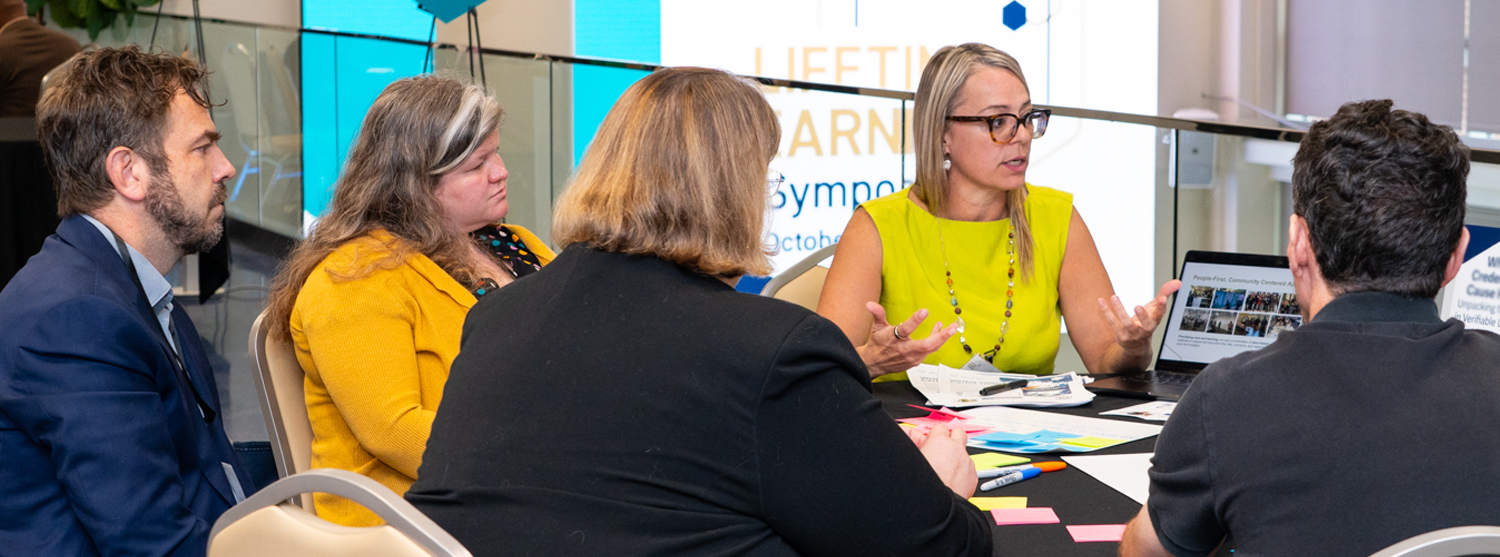
This year’s Lifetime Learning Symposium, Building a Learning Society, is exploring how the future of education is increasingly continuous, interconnected, and essential to ensuring individuals, communities, and organizations thrive, and how higher education plays a central role in this shift by designing the systems and models that enable learning across a lifetime.
Through forward-thinking sessions, we will challenge assumptions, share real-world models, and discuss actionable strategies to build a true learning society without age, geography, or traditional pathway barriers.
We invite proposals aligned with the following topics:
Activating the Learning Lifecycle
It is imperative that higher education evolves its model to support learners at every stage of life. This topic tackles the value propositions necessary to build integrated learning ecosystems and deliver transformative learner outcomes. Sessions will investigate the policy, governance, and partnership models needed to establish lifetime learning as the foundational pillar of the modern university.
Actualizing Access Through Scale
How can institutions design and deliver high-quality learning that meets the global demand for access? This topic examines technology-enabled models that dismantle traditional barriers while promoting at-scale sustainability. Sessions will outline the operational frameworks and learning systems necessary to ensure higher education dramatically expands both reach and opportunity.
Authoring the New Credentialing Landscape
Higher education has long been the arbiter of knowledge, but credentialing is evolving to reflect the needs of our rapidly changing world. This topic investigates interoperable credentialing ecosystem design in a landscape of nonlinear pathways. Sessions will highlight strategies to build trust, enhance mobility, and provide learners with increased agency in a rapidly changing world.
Proposals should be approximately 200-300 words in length and must be submitted by Sunday, June 14, 2026.